
Banana bread is a quick bread made with mashed ripe bananas, melted butter, and just enough flour to hold everything together. It takes one bowl, no mixer, and about 10 minutes of hands-on time.
The difference in this recipe is melted butter, not softened. Skipping the creaming step means the batter comes together by hand in under 5 minutes, and it bakes into a denser, more pound-cake-like crumb that slices cleanly even while still warm.
This is the recipe for the 3 blackened bananas sitting on your counter right now.
WHY YOU’LL LOVE THIS
- One bowl, one spoon, no electric mixer required
- Ready from counter to oven in about 10 minutes of prep
- Stays moist for 4 full days at room temperature, wrapped well
- Uses 3 bananas you’d otherwise throw out
- Bakes in 55 to 65 minutes at 350°F, no advance planning needed
- Freezes whole or sliced for up to 3 months
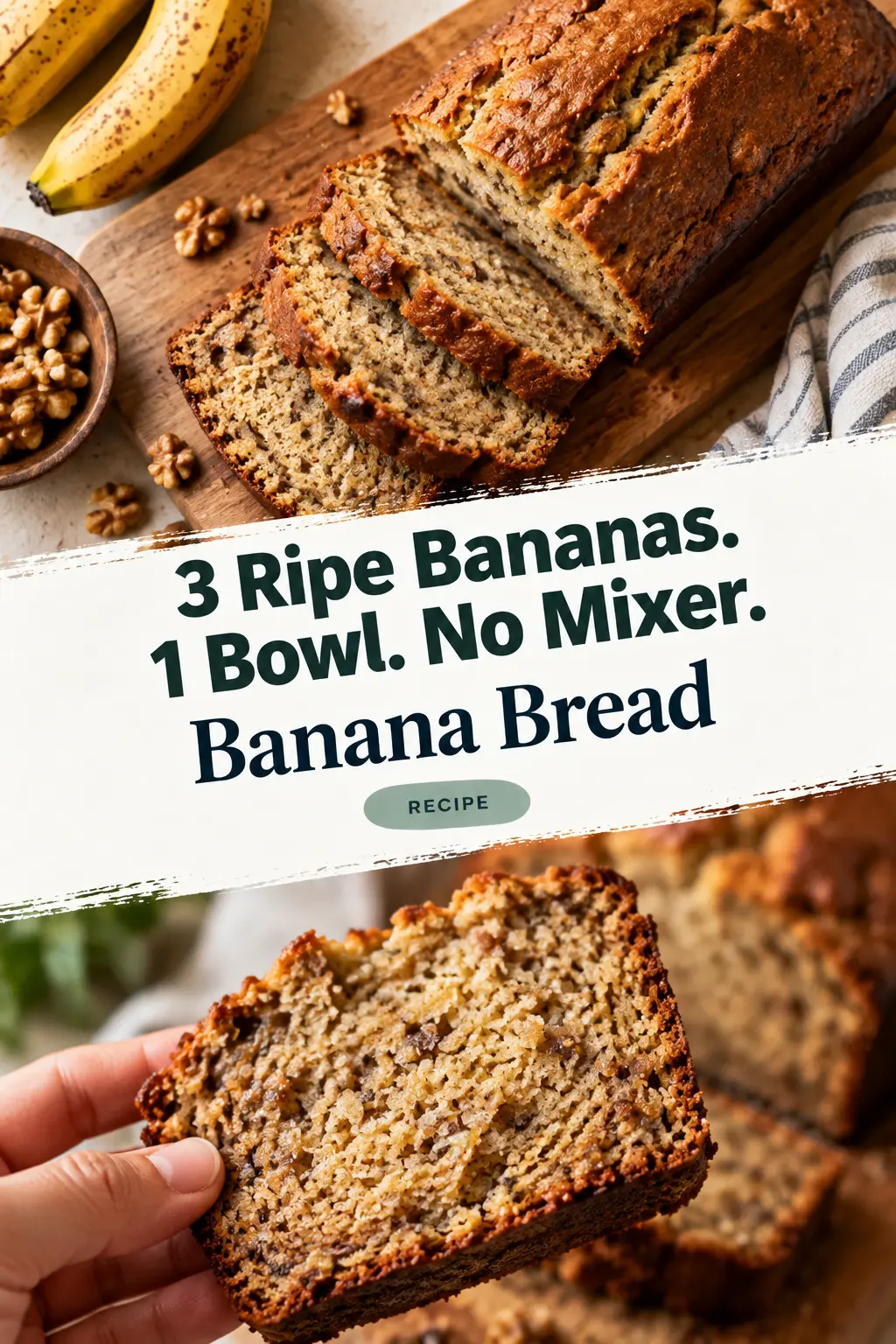

Easy Banana Bread Recipe (Moist, One-Bowl)
Ingredients
Equipment
Method
- Preheat and prep. Preheat the oven to 350°F (175°C). Grease a 9×5-inch loaf pan or line it with parchment, leaving overhang on the long sides for easy lifting.
- Mash the bananas. Mash the 3 bananas in a large bowl with a fork until mostly smooth with a few small lumps left. You should have about 1½ cups of mashed banana — this is what keeps the loaf moist, so don’t skimp.
- Mix the wet ingredients. Stir the melted butter into the mashed banana. Add the sugar, egg, and vanilla, and whisk until combined. The mixture will look glossy and slightly foamy on top after about 30 seconds of whisking.
- Add the dry ingredients. Sprinkle the baking soda, salt, and cinnamon (if using) over the wet mixture, then add the flour. Fold with a spatula just until no dry streaks remain, about 15 to 20 strokes. Stop as soon as the flour disappears — overmixing develops gluten and makes the loaf tough and rubbery instead of tender.
- Fold in add-ins. If using nuts or chocolate chips, fold them in now with 2 to 3 more strokes.
- Pour and bake. Pour the batter into the prepared pan and smooth the top. Bake for 55 to 65 minutes. Check doneness at 55 minutes: a toothpick inserted in the center should come out with a few moist crumbs, not wet batter, and the internal temperature should read 200 to 205°F on an instant-read thermometer. The top will be deep golden brown and may have a single long crack down the center — that’s normal, not a flaw.
- Cool before slicing. Let the loaf cool in the pan for 10 minutes, then lift it out onto a wire rack using the parchment overhang. Cool for at least 30 minutes before slicing — cutting it warm makes the crumb gummy, even though it smells impossible to resist.
Notes
Not naturally allergen-free.
Gluten-free: swap in a 1:1 gluten-free flour blend; texture will be slightly more crumbly and less structured when sliced warm.
Dairy-free: swap melted butter for neutral oil; flavor is a little less rich but texture holds up well.
Egg-free: see flax egg sub above.
PRO TIPS / TROUBLESHOOTING
- My loaf is dense and gummy in the middle. Cause: underbaked, or too much banana relative to flour. Fix: bake until internal temp hits 200 to 205°F, not just until the top looks brown; tent with foil after 40 minutes if it’s browning too fast.
- The top burned but the inside is raw. Cause: oven runs hot, or a dark/nonstick pan absorbed too much heat. Fix: drop the temperature to 325°F and add 10 to 15 minutes, or tent loosely with foil at the 30-minute mark.
- It sank in the middle after baking. Cause: underbaked, oven opened too early, or too much leavener. Fix: don’t open the oven before 45 minutes; measure baking soda with a level, not heaping, teaspoon.
- It’s dry and crumbly, not moist. Cause: bananas weren’t ripe enough, or too much flour was packed into the measuring cup. Fix: use bananas that are mostly brown-spotted to black; spoon flour into the cup and level it instead of scooping.
- It stuck to the pan. Cause: pan wasn’t greased into the corners, or it was flipped out too soon. Fix: grease every corner and edge, or use a parchment sling; let it cool in the pan for the full 10 minutes before lifting.
- I doubled the batch and it didn’t turn out the same. Cause: two loaves in one oven bake unevenly, and doubled wet ingredients change mixing time slightly. Fix: bake loaves on separate racks and rotate halfway through; check each loaf’s temp individually since they won’t finish at the exact same time.
- It’s bland. Cause: bananas weren’t ripe enough, or salt was skipped. Fix: don’t skip the ½ tsp salt — it’s what makes the banana flavor taste full instead of flat; let bananas ripen a few extra days if needed.
- The nuts or chocolate chips all sank to the bottom. Cause: add-ins were mixed in wet, without any flour coating. Fix: toss add-ins in 1 teaspoon of flour before folding them into the batter.
VARIATIONS
- Air fryer version: Pour batter into a pan that fits your air fryer basket (or a smaller loaf pan). Bake at 320°F for 35 to 40 minutes, checking at 30. Air fryers brown faster, so tent with foil if the top darkens early.
- Muffins instead of a loaf: Divide batter into a lined 12-cup muffin tin. Bake at 350°F for 18 to 22 minutes; check with a toothpick at 18.
- Gluten-free: Swap in a 1:1 gluten-free flour blend. The crumb will be slightly more delicate and crumbly when sliced warm; cooling fully before slicing matters even more here.
- Dairy-free: Use a neutral oil instead of melted butter. Flavor is a touch less rich but the texture stays just as moist.
- Brown butter version: Brown the butter in a light-colored skillet over medium heat for 4 to 5 minutes, until it smells nutty and turns amber, then let it cool for 10 minutes before mixing in. This adds a deeper, toasty flavor.
- Chocolate banana bread: Replace ¼ cup of the flour with ¼ cup unsweetened cocoa powder, and fold in ½ cup chocolate chips.
MAKE-AHEAD, STORAGE, REHEATING, FREEZING
- Make-ahead: Mash the bananas and measure the dry ingredients up to 1 day ahead; store separately, combine right before baking.
- Room temperature storage: Wrap the cooled loaf tightly in plastic wrap or store in an airtight container. Keeps well for 4 days; the crumb actually improves on day 2 as the moisture evens out.
- Refrigerator: Not necessary and can dry it out faster than the counter; only refrigerate in hot, humid climates, and expect a slightly firmer texture.
- Freezing: Wrap the whole cooled loaf (or individual slices) tightly in plastic wrap, then foil, and freeze for up to 3 months. Label with the date.
- Reheating: Thaw at room temperature for 2 to 3 hours, or microwave a single slice for 15 to 20 seconds. To re-crisp the crust on a thawed whole loaf, warm it in a 300°F oven for 10 minutes.
- What degrades: Add-ins like nuts lose crunch after freezing; the crust softens over time regardless of storage method. This is normal, not spoilage.
WHAT TO SERVE WITH IT
- A smear of salted butter, still warm
- Coffee or chai for breakfast
- Vanilla or cinnamon whipped cream for a dessert version
- A drizzle of honey or maple syrup
- Sliced and toasted with cream cheese
- A scoop of vanilla ice cream, warmed loaf, for dessert
FAQ
Why did my banana bread come out dense? It’s usually underbaked or overmixed. Check that the internal temp hits 200 to 205°F, and fold the flour in just until the streaks disappear, no more.
Can I use frozen bananas? Yes. Thaw them fully first and drain off any excess liquid before mashing, or the batter will be too wet.
How many bananas is 1½ cups mashed? Usually 3 large bananas, but it depends on size. Mash first, then measure to be exact.
Can I make this ahead for a party? Yes. It actually tastes better on day 2, once the moisture has evened out through the crumb overnight.
Why is my baking soda important here? Baking soda needs an acidic ingredient to activate, and ripe bananas provide that acid. Baking powder won’t give the same rise or crumb.
Can I substitute oil for butter? Yes, use the same amount of neutral oil. The texture stays just as moist; the flavor is slightly less rich.
Why does the recipe say to cool before slicing? The crumb is still setting as it cools. Slicing while warm makes it gummy and can tear instead of cutting cleanly.
Can I double this recipe? Yes, bake two separate loaves rather than one giant one, and check each loaf’s internal temp individually since they may finish a few minutes apart.
Made this? Leave a star rating and a comment below, it’s how this recipe gets found by other people searching for it, and how future versions get better. If you try one of the variations above, let me know how it turned out.



Leave a Reply