
This bread sauce recipe makes the creamy, gently spiced sauce that sits beside the turkey on a British Christmas table. Milk is infused with onion, cloves and bay, thickened with soft white breadcrumbs, then finished with butter, cream and fresh nutmeg. Bread sauce goes back to at least the mediaeval period, when bread was a common way to thicken a sauce.
I wrote this version because the recipes online don’t agree with each other. Some use 100 g of crumbs for 600 ml of milk, and others use more than twice that much for the same amount of milk. Almost none tell you how much sauce you end up with. Below I’ve worked out the maths, set a ratio I trust, and added the storing and fixing advice that I think is missing. It takes about 90 minutes, but only about 30 of those are hands-on.
Jump to the recipe card at the end of this page for exact quantities and a printable version.
What’s in It
Whole milk is the base, flavoured with an onion studded with whole cloves, a bay leaf and black peppercorns. Day-old white bread, with the crusts cut off, is blitzed into crumbs to thicken it. Unsalted butter and double cream go in at the end, along with fresh nutmeg, salt and pepper. You need a medium saucepan (about three times the volume of the milk, so it has room to foam up), a food processor for the crumbs, a sieve or slotted spoon, and a warm jug to serve it in.
Where This Recipe Comes From
Bread sauce doesn’t belong to one cook, so I’m not crediting it to anyone. The method here (infuse the milk, take out the flavourings, stir in crumbs, finish with butter and cream) is the same basic route used in the versions published by Delia Smith, BBC Good Food and others. The quantities are my own settings, based on the comparison further down.
Choosing the Bread
Use plain white bread that is a day or two old, with the crusts removed. Stale bread is drier, so it breaks into clean crumbs and soaks up the milk evenly. I would skip sourdough. My reading is that its tang and chewy crumb don’t suit such a mild sauce. Weigh the bread after you trim it, because slice sizes vary a lot. Dried packet crumbs and panko work too, but they hold less water to start with, so they usually soak up more milk. Start with a little less and add more if the sauce looks loose.
How I Make It
- Make the crumbs. Cut the crusts off the day-old bread. Tear it up and blitz it in a food processor until you have fine, soft crumbs, then weigh out 110 g. No processor? Use the coarse side of a box grater.
- Stud the onion. Halve a medium onion through the root. Push 3 whole cloves into each half, so 6 in total. Studding keeps the cloves in one place, so you can lift them out later without fishing through the sauce.
- Heat the milk. Put 600 ml whole milk in a medium saucepan with the onion, 1 bay leaf, 8 black peppercorns and 1/2 tsp fine salt. Warm it over a medium heat until it just starts to simmer, stirring now and then so it doesn’t catch on the base. Milk rises fast, so don’t walk away.
- Take the pan off the heat, put the lid on and leave it for 1 hour. You can leave it for up to 2 hours if you want a stronger flavour. This step is only for flavour. Nothing is cooking, so it’s the easiest part to do early.
- Lift out the onion, bay leaf and peppercorns with a slotted spoon, or pour the milk through a sieve into a clean pan. Taste the milk. It should taste gently of onion and spice.
- Add the crumbs. Put the pan back on a low heat. Stir in the 110 g of crumbs and 25 g of the butter. Cook gently for about 10 minutes, stirring often and scraping the base. It’s ready when the crumbs have broken down, there are no dry specks, and a spoon leaves a slow trail. It keeps thickening as it stands, so stop while it’s a touch looser than you want.
- Stir in 4 tbsp double cream and the other 25 g of butter. Grate in a little fresh nutmeg, then taste and add salt and pepper. If it’s too thick, stir in a splash of milk. Pour it into a jug you’ve warmed with hot water.
- Keep it warm. If the roast isn’t ready, take the pan off the heat and cover it. Delia Smith’s method puts the clove-studded onion back in the pan while it waits, which keeps the flavour coming. Take it out again before serving, then reheat gently with a splash of milk.
The Crumb-to-Milk Ratio Nobody Explains
Bread sauce recipes vary a lot in how much bread they use. I divided the weight of crumbs by the volume of milk for six published versions. The last column is grams of crumbs per 100 ml of milk. I worked these figures out myself, from the quantities each recipe prints.
The thickest version is more than twice as thick as the thinnest, and they all carry the same name. The two thickest both tell you to adjust as you go. The Aga recipe says to add extra milk or crumbs if the sauce is too thick or thin, and the BBC version says to add a splash more milk if you want it thinner.
I went with 110 g to 600 ml, which is close to Delia’s ratio. It gives a soft, spoonable sauce that still pours from a jug. If you want it thicker, stir in a tablespoon of crumbs while it cooks and give it 3 minutes to swell before adding more. If you want it thinner, add milk a tablespoon at a time. Judge the thickness after the cream goes in, because it loosens the sauce a little.
The Pint Problem Nobody Mentions
Some bread sauce recipes, especially American ones, give the milk as 1 pint. A British pint is 568 ml. An American pint is 473 ml. That’s a gap of about 20 per cent (568 divided by 473 is 1.2). If you use the smaller pint with the same weight of bread, the sauce comes out much thicker.
Here is an example. One popular American version uses 5 ounces of bread, which is about 142 g. Against a British pint that works out at 25 g per 100 ml. Against an American pint it’s 30 g per 100 ml, which is thicker than every version in the table above except the two that use 300 ml of milk. I did that sum myself, and I don’t know which pint the author meant. The fix is simple: weigh your milk in millilitres, as the card in this recipe does.
How Much Sauce Do You Actually Get?
Most recipes say “serves 8” and stop there. Here is my arithmetic. 600 ml of milk weighs about 620 g, because milk is slightly heavier than water. Add 110 g of crumbs, 50 g of butter and about 58 g of cream (4 tbsp), and you have roughly 840 g before cooking. After steam and the little milk left on the onion, my estimate is about 780 g of finished sauce.
That makes eight portions of about 100 g, or six large ones of about 130 g. As a cross-check, Asda’s version (600 ml milk, 125 g bread, 25 g butter and 3 tbsp cream) lists six servings of 124 g each. That’s 744 g, which is close to my figure. A simple rule is about 75 ml of milk per person. Use this chart to scale up or down.
The pan size is my own rule of thumb: about three times the volume of the milk, so it doesn’t boil over. Scale the onion, cloves and peppercorns in line with the milk, and always use at least one bay leaf. Keep the infusing time the same, and add 2 or 3 minutes to the crumb stage for the bigger batches.
Common Mistakes and How I Fixed Them
Lumpy sauce. The cause is usually crumbs dumped in as a clump, or crumbs that are too coarse. Whisk it hard, or use a stick blender for a few seconds with a splash of extra milk. A handheld blender is also the fix on one supermarket version of this recipe.
Too thick, or set like porridge. The cause is a high crumb ratio, or a sauce that stood for a while while the crumbs kept drinking milk. Warm it gently and stir in milk, a tablespoon at a time, until it loosens.
Too thin. The cause is too few crumbs, or stopping the cooking too early. Cook it for 2 more minutes. If it’s still loose, stir in a tablespoon of crumbs and wait 3 minutes, because the crumbs need time to swell.
Bland flavour. The cause is a short infusion, old spices or too little salt. Add salt a pinch at a time, and grate in fresh nutmeg. Next time, leave the milk to infuse for the full 2 hours.
Skin on top. The cause is the milk surface drying as it stands. Press a piece of baking parchment onto the surface of the sauce. This is the tip the BBC Good Food team gives in the comments on its own recipe.
Scorched taste. The cause is heat that is too high, or too little stirring, so the milk catches on the base. Pour the sauce into a clean pan without scraping the bottom, so the burnt bits stay behind. Keep the heat low next time.
Grainy or split after freezing. The cause is the cream separating in the freezer. Freeze the sauce before the cream goes in, and add the cream when you reheat it.
Variations and Substitutions
- No cloves: use 1/2 tsp freshly grated nutmeg in the milk instead. Delia Smith suggests this too.
- Richer: swap the double cream for mascarpone, or stir a spoonful of roast juices into the finished sauce.
- Lighter: single cream works, and you can skip the cream entirely if you like.
- Garlic and thyme: BBC Good Food adds 2 garlic cloves and 3 thyme sprigs to its version. Put them in with the milk and remove them with the onion.
- Pale and smooth: use white pepper instead of black, and strain the milk through a fine sieve.
- Dairy free: use unsweetened plant milk, plant cream and plant butter. The sauce will taste different, so taste and adjust the salt and nutmeg.
- Gluten free: use gluten-free white bread. Check the crumb ratio as you cook, because gluten-free crumbs can soak up liquid differently.
What to Serve With It
Bread sauce is made for roast turkey, chicken and game birds. It sits well next to cranberry sauce, Brussels sprouts, roast potatoes, stuffing, pigs in blankets and plenty of gravy. It’s also very good in a cold turkey sandwich the next day, where a layer of cold bread sauce does the job of mayonnaise.
Make Ahead, Storing and Freezing
Make ahead. The easiest way is to do the infusing and straining earlier in the day, or the day before, and keep the strained milk covered in the fridge. Then add the crumbs about 15 minutes before you serve. That way the texture is freshly made, and the long wait is already done.
How Long Does Bread Sauce Really Keep?
The advice online doesn’t agree. The BBC Good Food recipe says it can be made up to 3 days ahead. Its own team says 2 days in the comments. Another site says 4 days. The UK Food Standards Agency advises that leftovers should be cooled and put in the fridge within 2 hours, and eaten within 2 days. I go with 2 days, because it’s a milk-based sauce and that is the official guidance.
Fridge. Cool the sauce quickly, cover it and chill it within 2 hours. It sets firm when cold, which is normal. Reheat it gently in a pan with a splash of milk, stirring, until it is steaming hot all the way through. If you use a microwave, heat it in short bursts and stir between each one. Reheat it once only.
Freezer. BBC Good Food and Delicious magazine both say bread sauce freezes for up to 1 month. Freeze it before adding the cream, as Delicious does, then thaw it overnight in the fridge. Add the cream and a knob of butter when you reheat it, and use it within 24 hours of defrosting.
Bread Sauce FAQs
What is bread sauce made from? Milk infused with onion, cloves and bay, thickened with white breadcrumbs, and finished with butter, cream and nutmeg.
What do you eat bread sauce with? Roast turkey, chicken and game birds, usually with cranberry sauce, sprouts and gravy. It’s also good cold in a leftover turkey sandwich.
Can you make bread sauce ahead? Yes. Infuse and strain the milk in advance, then add the crumbs shortly before serving. A finished sauce keeps for 2 days in the fridge.
Can you freeze bread sauce? Yes, for up to 1 month. Freeze it without the cream, thaw it overnight in the fridge, then add the cream when you reheat it.
Can I use fresh bread instead of stale? Yes. Fresh bread is softer and holds more water, so the sauce may thicken a little less. Add an extra spoonful of crumbs if you need to.
Why is my bread sauce lumpy? Usually the crumbs went in as a clump or were too coarse. Whisk it hard, or blitz it for a few seconds with a stick blender and a splash of milk.
Is bread sauce served hot or cold? Usually hot with the roast. It’s also eaten cold with leftover meat, and the Aga recipe says it is just as good that way.
Is bread sauce vegetarian or gluten free? It’s vegetarian, as there is no meat in it. It isn’t gluten free unless you use gluten-free bread.
One Last Thing
Bread sauce is simple, but it’s fussy about ratio and heat. Weigh the crumbs, keep the heat low, and stop cooking while the sauce is slightly looser than you want, because it keeps thickening as it stands. If you only make one thing ahead, make the infused milk. The rest takes about 15 minutes before you serve.
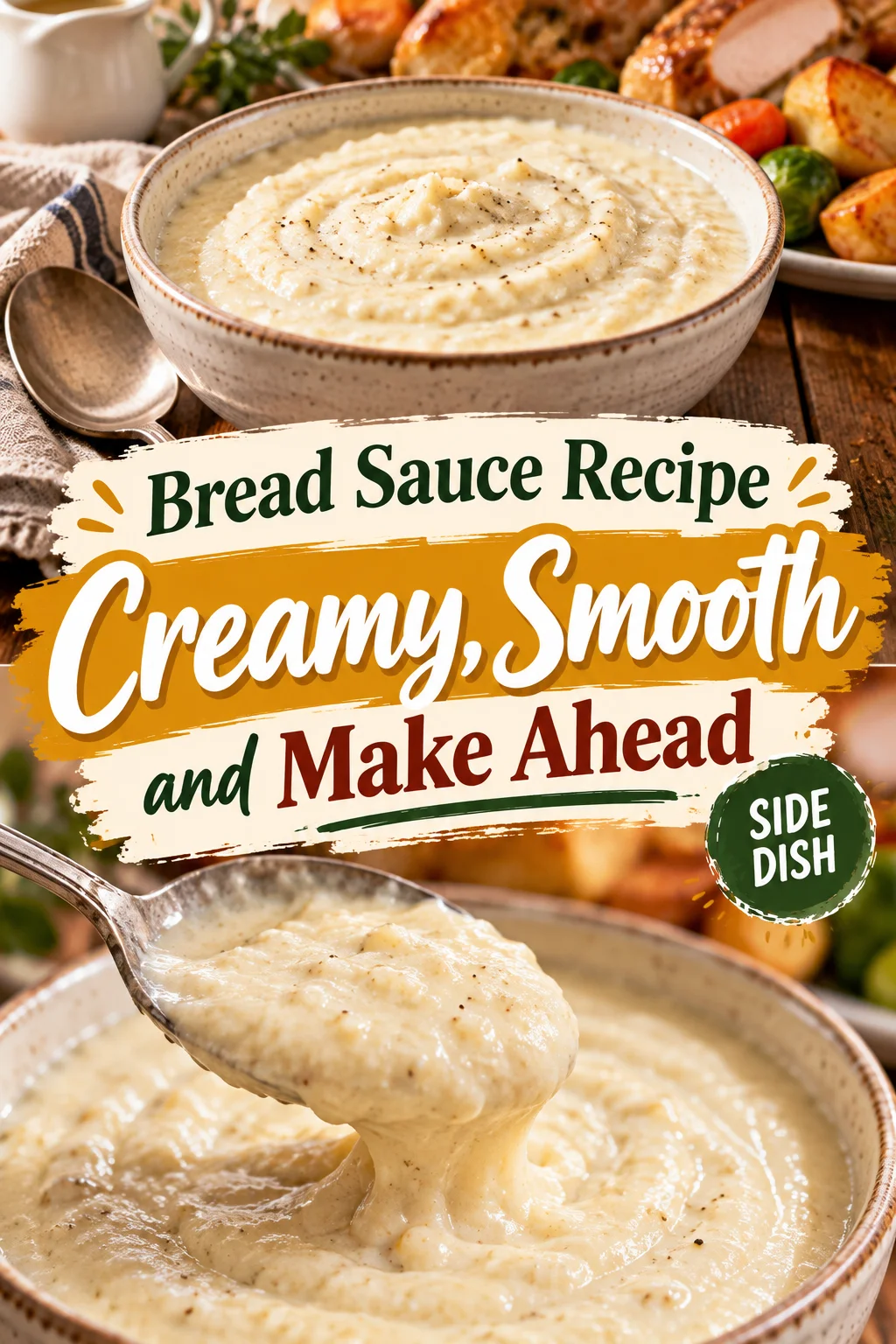

Bread Sauce Recipe
Ingredients
Equipment
Method
- Make crumbs. Cut the crusts off the bread. Blitz it in a food processor until fine, then weigh out 110 g.
- Stud onion. Push 3 cloves into each onion half.
- Heat milk. Put the milk, onion, bay leaf, peppercorns and salt in a medium saucepan. Warm over a medium heat until the milk just starts to simmer.
- Infuse milk. Take the pan off the heat, cover and leave for 1 hour. Leave for up to 2 hours for a stronger flavour.
- Strain. Lift out the onion, bay leaf and peppercorns.
- Add crumbs. Put the pan on a low heat. Stir in the crumbs and half the butter (25 g).
- Cook gently. Cook for about 10 minutes, stirring often, until the crumbs have broken down and a spoon leaves a slow trail.
- Finish sauce. Stir in the cream and the remaining 25 g butter. Add the nutmeg. Taste, then season with salt and pepper. Add a splash of milk if too thick.
- Serve warm. Pour into a warm jug. Serve straight away, or cover and keep warm off the heat until needed.
Notes
- No oven is needed, so there is no fan or gas mark conversion. Use a medium heat to bring the milk to a simmer, then a low heat for the crumbs.
- Use a pan about three times the volume of the milk (2 litres for 600 ml) so it doesn’t boil over.
- Timing cue: the sauce is ready when the crumbs have fully broken down, there are no dry specks, and a spoon leaves a slow trail. It thickens as it stands, so stop slightly loose.
- Key tip: fix a lumpy sauce with a whisk, or a few seconds with a stick blender and a splash of milk.
- Storing: cool within 2 hours, cover and chill for up to 2 days. Reheat gently with a splash of milk until steaming hot.
- Freezing: freeze before adding the cream, for up to 1 month. Thaw overnight in the fridge, use within 24 hours, and add the cream when reheating.
Have You Tried This Creamy Bread Sauce Recipe?
I’d love to hear how your bread sauce turned out! Did you make it ahead for Christmas dinner, serve it with a Sunday roast, or add your own little twist?
Leave a comment below and let me know how it went. If you enjoyed the recipe, don’t forget to leave a rating! Your feedback helps other home cooks and makes my day.



Leave a Reply