
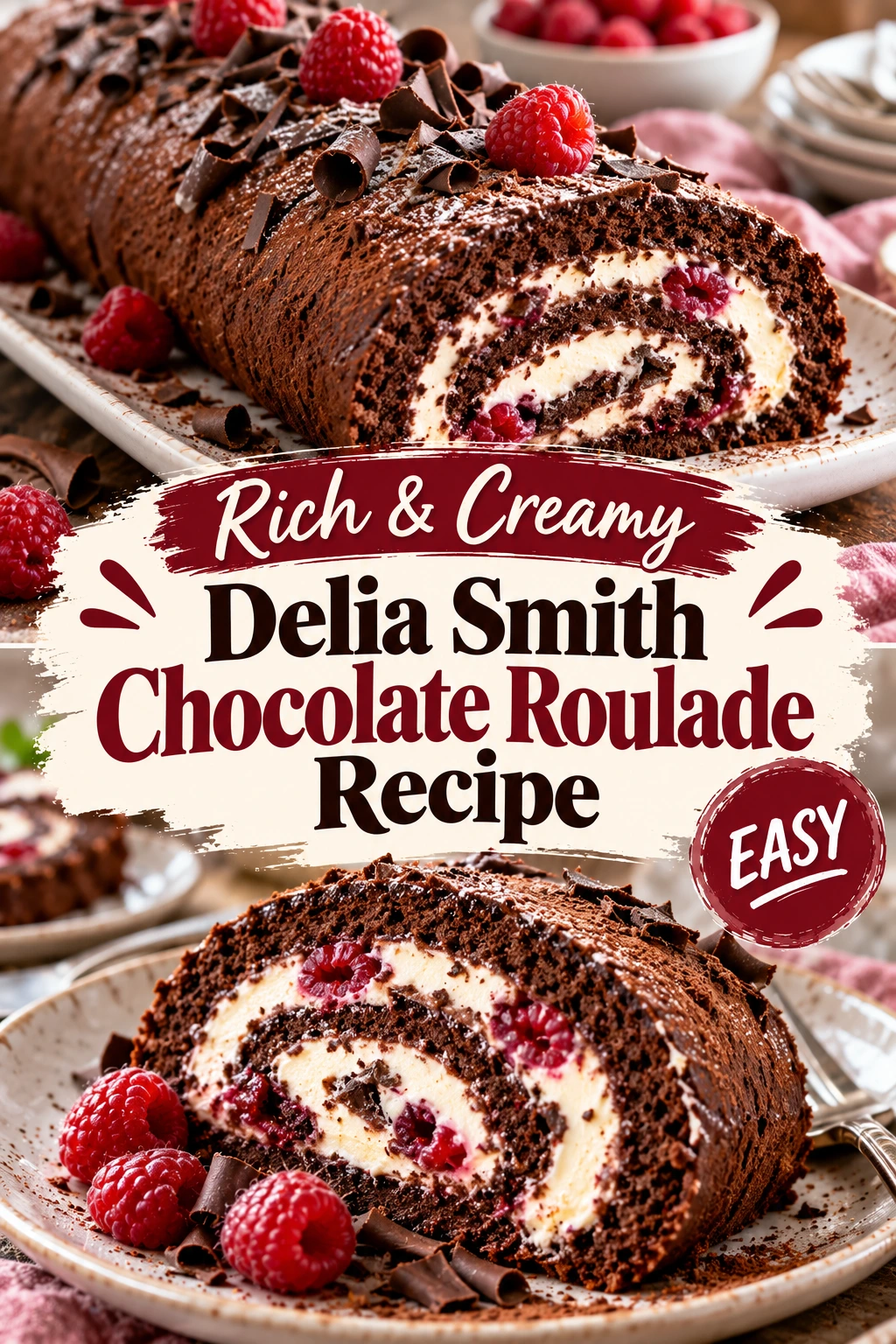
If you searched for a Delia Smith chocolate roulade recipe, the cake most people mean is her Squidgy Chocolate Log from Delia Smith’s Complete Cookery Course. It’s a cocoa sponge with no flour, rolled around a layer of chocolate mousse and a layer of softly whipped cream. It cracks when you roll it, and that’s part of how it’s meant to look.
I noticed something odd while checking the quantities. Several popular pages sell a different cake under Delia’s name. It has melted chocolate in the sponge and no cocoa, and it matches Mary Berry’s books instead. Below I give you Delia’s version, tell you where I checked it, and explain the differences so you end up with the cake you wanted.
Jump to the recipe card at the end of this page for exact quantities and a printable version.
What’s in It
The sponge is made from eggs, caster sugar and cocoa powder, with no flour at all. The filling has two layers: a chocolate mousse made from plain chocolate, a little water and two extra eggs, then softly whipped double cream. A dusting of icing sugar finishes it. You’ll need a Swiss roll tin about 29 x 18cm (11.5 x 7 inches) and roughly 2.5cm (1 inch) deep, baking parchment, an electric whisk and a large metal spoon for folding.
Roulade or Squidgy Chocolate Log?
Same cake, two names. Delia’s book calls it Squidgy Chocolate Log, and most websites call it a chocolate roulade. I use roulade here because that’s the word people search for, but if you’re looking in the book, look for the log.
Is This Really Delia’s Recipe?
Mostly yes, with two honest caveats. First, I could not find a page for it on Delia’s official website. The chocolate roulade you’ll find there is a different one, made with hazelnut meringue. Second, I haven’t had the book in my hands, so the method wording below is my own.
What I did instead was compare several independent cooks who credit the Complete Cookery Course. They agree on the sponge (six eggs, caster sugar and cocoa, no flour) and on the filling (plain chocolate, a little water, two eggs and double cream). Where they differ, such as the oven temperature, I tell you which way I went and why.
How I Make It
- Heat the oven and line the tin. Heat the oven to 180°C (160°C fan, gas 4). Lightly grease a 29 x 18cm Swiss roll tin and line the base and sides with baking parchment.
- Melt the chocolate first. Break the chocolate into a heatproof bowl, add the water and set it over a pan of barely simmering water. The bowl shouldn’t touch the water. Let it melt, then stir until smooth. I make the mousse first because it needs about an hour in the fridge, and that hour runs while the sponge bakes and cools.
- Finish the mousse. Beat the two yolks, then beat them into the warm chocolate. Let it cool a little. Whisk the two whites until stiff and fold them in. Cover the bowl and chill for about an hour. The chocolate should be warm, not hot, or it can start to cook the yolks.
- Whisk the sponge yolks and sugar. In a large bowl, whisk the six yolks until they start to thicken. Add the sugar and keep whisking until the mixture thickens a little more. Delia’s warning here is not to let it get too thick, so stop sooner than you think.
- Add the cocoa. Sift the cocoa over the yolk mixture, then mix until combined. It will feel heavy, and that’s fine. The whites do all the lifting.
- Whisk the sponge whites to soft peaks. Use a clean bowl and a clean whisk. Stop at soft peaks, where the tips flop over. My reading is that soft peaks fold into the heavy cocoa base with less lumping than stiff ones, and every source I checked uses soft peaks for the sponge.
- Loosen, then fold. Stir about a third of the whites into the cocoa mixture to loosen it. Then fold in the rest with a large metal spoon, keeping as much air as you can. Stop as soon as you can’t see white streaks.
- Pour the mixture into the tin, then lift and tilt the tin so it settles evenly into the corners. Bake on the middle shelf for 20 to 25 minutes. Start checking at 20. It’s done when it springs back if you press it lightly.
- Cool in the tin. Leave the sponge in the tin until completely cold. It will sink a lot as it cools. That’s normal, so don’t think you’ve done something wrong.
- Turn it out. Lay a fresh sheet of parchment, a little bigger than the cake, on the worktop and dust it with icing sugar. Turn the sponge onto it and peel off the lining paper.
- Fill it. Spread the chilled mousse over the sponge. Whip the cream until softly whipped, not stiff, and spread it over the mousse. I leave a narrow bare strip along the far edge, because over-filling is what makes it squeeze out at the ends.
- Roll it up. With a short end nearest you, lift the paper and roll the sponge over the filling into a log. Use the paper to help and keep the pressure gentle. If it cracks, push it back together. Dust with icing sugar and chill until you’re ready to serve.
The Recipe Mix-Up Nobody Explains
Search for this recipe and you’ll find two different cakes wearing the same name. One has melted chocolate stirred into the yolks and no cocoa powder. That is the formula in several Mary Berry books and on sites that publish her recipes, so it’s a great cake, but it isn’t Delia’s. One popular page even slips and writes “Mary/Delia” partway down.
Here’s the quick test I use. If a “Delia” recipe has no cocoa powder and no two extra eggs for a mousse, it isn’t the Squidgy Chocolate Log. The texture is different too, because Delia’s sponge is lighter and the mousse makes the filling softer and richer.
Why the Tin Size Matters
This one is my own arithmetic, not something Delia says. Her tin is about 29 x 18cm, which is 522 square centimetres. The tin used on the page that mixes up the two recipes is 33 x 23cm, which is 759 square centimetres. I divided 759 by 522 and got about 1.45, so the same amount of batter is roughly 45% deeper in Delia’s tin.
My reading is that this is why her sponge takes 20 to 25 minutes and sinks so much as it cools. If you only own a bigger tin, the sponge will be thinner and may be done sooner, so start checking a few minutes early. Don’t use a much bigger tin than that, or the sponge may get too thin to roll well.
Oven Temperature: 175°C or 180°C?
You’ll see both. The 175°C figure shows up on pages that converted from 350°F, which is really about 177°C. The UK sources I checked say 180°C, gas 4, so I use that.
The fan figure is the usual rule of thumb, 20°C lower. Every oven runs a little differently, so trust the spring test more than the clock.
How Many Slices You Get, and What They Cost
When you roll from the short end, the log is about 18cm long. Cut into 8 slices, each is a little over 2cm thick. Cut into 10, each is about 1.8cm. It’s rich, so 10 thinner slices works well after a big meal.
I also added up typical calorie values for each ingredient, including the mousse and the cream. The whole roulade comes to roughly 3,650 kcal. That’s about 455 kcal a slice for 8, or about 365 for 10. One popular page lists 350 kcal a slice for 8, but its recipe adds up to about 400 by the same method, so I’d treat that figure as low. These are estimates, not lab numbers.
Common Mistakes and How I Fixed Them
The sponge breaks into pieces when I roll it. The cause is usually overbaking, which dries it out. Take it out as soon as it springs back. If it still cracks, that’s normal. Push it back together and let the cream hold it.
The sponge is flat and dense. The cause is usually air knocked out of the whites, or yolks whisked until too thick. Fold in the whites in stages and stop as soon as the streaks go.
The mousse won’t go smooth. The cause is usually chocolate that got too hot, got splashed with water, or was very dark. One cook who tried darker chocolate said it never went smooth. Use plain chocolate of about 50 to 60% cocoa solids, keep the water barely simmering and keep the bowl dry.
The filling squeezes out at the ends. The cause is too much filling or rolling too hard. Leave a narrow bare edge and roll gently. If it oozes anyway, spread it back with a knife.
The sponge sticks to the paper. The cause is skipping the icing sugar on the parchment. Dust it before you turn the cake out.
Variations
Swap the mousse for sweetened chestnut purée (about 310g, which is the 11 oz one source gives). Use raspberry jam under the cream if you’d rather skip the mousse. Or make a chocolate ganache with cherries and a splash of cherry brandy, as one food blogger did with this same sponge.
What to Serve With It
Fresh raspberries or cherries cut through the richness well. A jug of pouring cream is fine, though the roulade already has plenty. Strong coffee finishes it off nicely.
Make Ahead, Storing and Freezing
Make ahead: You can fill and roll it earlier in the day. A Mary Berry version of the roulade can be made and rolled up to 24 hours ahead, and I follow the same limit for this one. Keep it chilled and covered loosely.
Storing: Keep it in the fridge. Because the mousse has raw egg in it, I’d finish it within 2 days. Take it out for 15 minutes before serving if you like the filling softer.
Freezing: The unfilled sponge freezes well, so wrap it in parchment, then foil. Defrost fully before filling. I haven’t found a tested source for freezing the filled roulade, so I wouldn’t.
FAQs
Is Delia Smith’s chocolate roulade gluten free?
There’s no flour in it, so it’s made without gluten. Check the labels on your cocoa, chocolate and icing sugar for “may contain” warnings if you’re cooking for someone with coeliac disease.
What size tin do I need?
A Swiss roll tin of about 29 x 18cm (11.5 x 7 inches) and about 2.5cm (1 inch) deep. A bigger tin gives a thinner sponge that bakes faster.
What temperature do I bake it at?
180°C (160°C fan, gas 4) for 20 to 25 minutes, until it springs back when pressed lightly.
Why did my chocolate roulade crack?
Flourless sponges nearly always crack when rolled, and Delia’s recipe says not to worry about it. Dust with icing sugar to hide the worst of it.
Is this the same as Mary Berry’s chocolate roulade?
No. Mary Berry’s melts chocolate into the sponge and has no cocoa or mousse. Delia’s uses cocoa in the sponge and a mousse and cream filling.
Can I use milk chocolate?
Delia’s version calls for plain chocolate. Some cooks use milk chocolate, but my reading is that the mousse will be softer and sweeter, so I’d stick with plain.
Is the mousse safe with raw eggs?
It uses uncooked egg, so people in higher-risk groups, such as pregnant women, should check the Food Standards Agency’s current advice on raw eggs before eating it.
Can I make it the day before?
Yes, you can fill and roll it a day ahead. Keep it chilled and covered, and eat it within 2 days.
One Last Thing
Check that the recipe you’re using has cocoa in the sponge and a mousse in the middle. If it does, you’ve got Delia’s cake. Let the sponge go completely cold before you roll it, and enjoy the cracks.

Delia Smith Chocolate Roulade
Ingredients
Equipment
Method
- Heat oven. Heat the oven to 180°C (160°C fan, gas 4). Grease a 29 x 18cm Swiss roll tin and line the base and sides with baking parchment.
- Melt chocolate. Put the chocolate and water in a heatproof bowl over a pan of barely simmering water. Stir until smooth, then take off the heat.
- Make mousse. Beat the 2 yolks, then beat them into the warm chocolate. Cool a little. Whisk the 2 whites until stiff and fold them in. Cover and chill for about 1 hour.
- Whisk yolks. Whisk the 6 sponge yolks until they start to thicken. Add the caster sugar and whisk until slightly thicker, but not very thick.
- Add cocoa. Sift in the cocoa and mix until combined.
- Whisk whites. In a clean bowl, whisk the 6 sponge whites to soft peaks.
- Fold gently. Stir in a third of the whites to loosen the mixture. Fold in the rest with a metal spoon until no streaks remain.
- Bake sponge. Pour into the tin and tilt to level. Bake on the middle shelf for 20 to 25 minutes, until it springs back when pressed.
- Cool completely. Leave the sponge in the tin until cold. It will sink.
- Turn out. Dust a fresh sheet of parchment with icing sugar. Turn the sponge onto it and peel off the lining paper.
- Fill sponge. Spread the chilled mousse over the sponge. Whip the cream softly and spread it on top, leaving a narrow bare edge.
- Roll up. Starting at a short end, use the paper to roll the sponge into a log. Dust with icing sugar, chill until serving and cut into 8 slices.
Notes
- Fan oven: 160°C. Gas mark 4. Some US conversions say 175°C, which is the same oven in practice.
- Tin size: 29 x 18cm. A larger tin gives a thinner sponge that may bake faster, so check a few minutes early.
- Doneness cue: the sponge should spring back when lightly pressed. Overbaking makes it break when you roll it.
- Cracks are normal. Push the roulade back together and dust with icing sugar.
- Storage: keep chilled and covered, and eat within 2 days. The mousse contains raw egg. The unfilled sponge can be frozen.
- Source: based on the Squidgy Chocolate Log in Delia Smith’s Complete Cookery Course, checked against several independent cooks. Method wording is my own.
Tried This Chocolate Roulade? I’d Love to Hear From You!
Did you make this Delia Smith-inspired Chocolate Roulade Recipe? I’d love to know how yours turned out! Did you keep the filling classic or add your own delicious twist?
⭐ If you enjoyed this recipe, please leave a rating and share your experience in the comments below! Your feedback helps other home bakers and means so much to me here at Cooking Picks.
Happy baking!

Leave a Reply